Build software from your phone with AI coding agents that run on your own machine.
Close the lid and walk away — the agents keep working while you steer them.
REM sleep, for code.
REM:Code turns your phone into a remote for the coding agents running on your computer. Direct Claude Code or OpenAI Codex from a native iOS or Android app or the web: follow the work live, answer permission prompts, review diffs and commit, open the result as a page.
When the thing you're building is an app, the agent ships a fresh iOS or Android build straight to the phone in your hand. The agent connects out through a secure tunnel, so there are no ports to open and nothing to host — the agents and your code run on your own machine.
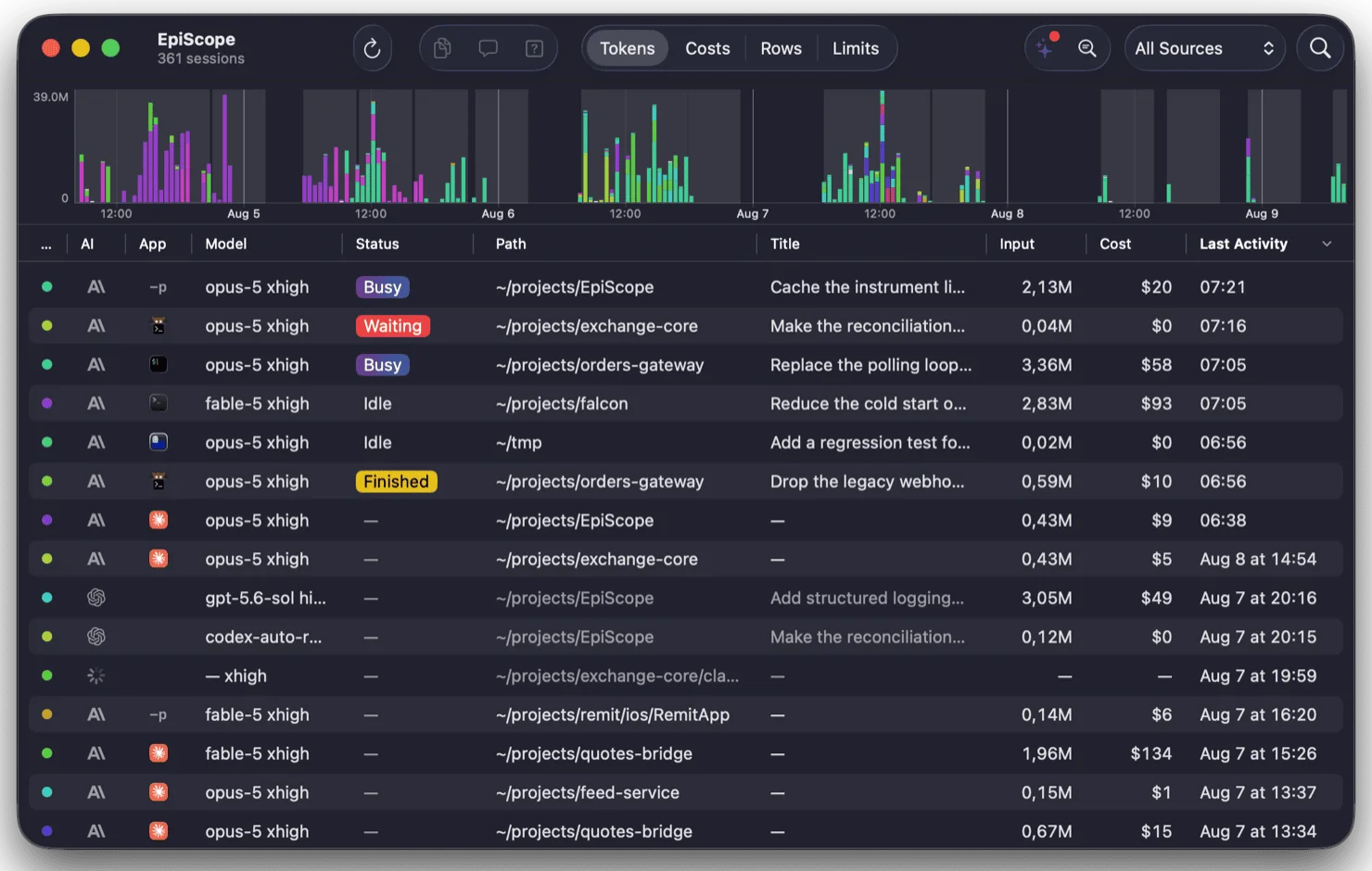
Every AI coding session on your Mac in one window — Claude Code, Codex and Claude Desktop:
live status, tokens, cost, transcripts and a spend timeline. The menu-bar icon lights up the
moment a session waits on a permission prompt.
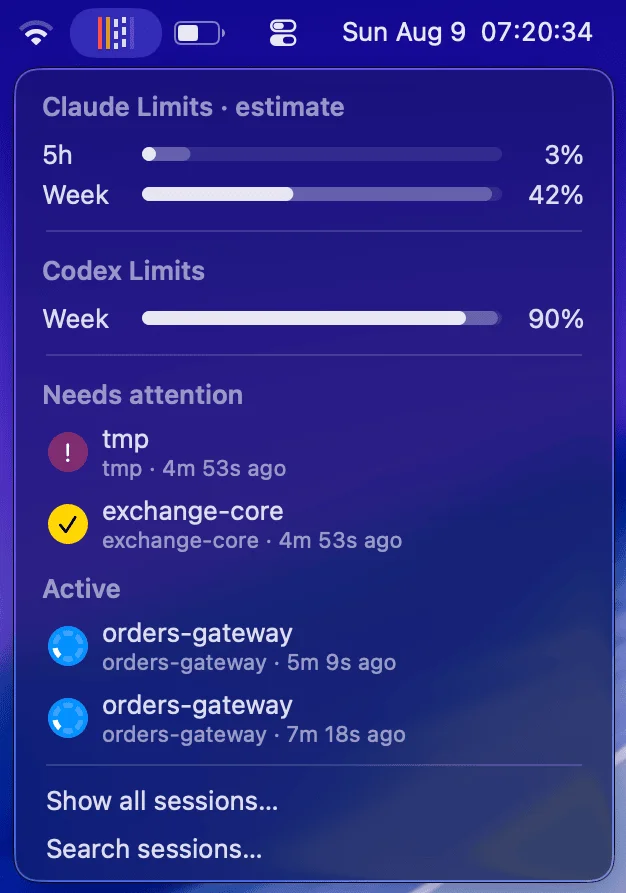
EpiScope is a native control center for AI coding agents. It watches every Claude Code, Codex and Claude Desktop session on the machine — live status, tokens and cost, full transcripts — with a spend timeline across the whole fleet. The menu-bar icon turns red and blinks the instant any session needs a permission prompt.
Full-text search over every conversation, usage limits at a glance, and optional AI Insights that write you a daily and weekly report. Pure AppKit, no dependencies; everything is computed locally and nothing leaves the Mac.
brew install --cask AlmazKo/tap/episcope
Blue Thread
iOSwatchOSmacOS
Replay every route of your day. Blue Thread quietly records where you go and turns each day
into a thread you can scrub through on the map. Private by design: it stays on your device
and syncs only to your own iCloud.
No check-ins, no buttons to press. Open the app days, months or years later and see exactly where you were at any moment: drag the time slider and watch your position move along the day's route, coloured by speed so walking, cycling and driving stand apart. Stops collapse into a single pin with arrival and departure times, and a timeline lists every stop with the distance and mode of travel between them.
A personal heatmap shows where you actually spend your time, with daily distance and steps from Apple Health. Recording survives app suspension, three power modes trade battery for detail, and an Apple Watch companion fills the gaps when the phone stays home. Nothing is shared with anyone.
Learn Castilian Spanish — the Spanish of Spain, not a Latin American mix. A dictionary with
audio, A1–B2 courses, grammar, dialogues and five ways to drill your words.
Secundarium is a free platform for learning the Spanish spoken in Spain. A dictionary with pictures, examples and audio for every word; practice through flashcards, writing, crosswords and a sprint; step-by-step courses from A1 to B2, a grammar reference, reading texts, dialogues and a travel phrasebook.
Pick your level once and all the content adapts to it. Progress follows your account, the interface speaks English and Russian, and teachers can sign up to bring their own materials.
The bear necessities of Kubernetes — a minimal native cluster viewer for developers, not
ops. Browse resources, inspect pods, follow logs, port-forward and pull flame graphs.
Read-mostly and prod-safe.
Kub is a minimal native Kubernetes viewer for developers, not ops. Browse ~22 resource kinds across namespaces, inspect a pod's containers and health, follow logs, read events, port-forward, scrape Prometheus /metrics and pull JVM heap dumps or async-profiler flame graphs.
It reuses your kubeconfig (EKS exec-auth included) and stays prod-safe: secret values never appear on screen, and every mutating action goes through a prod-flagged confirm that shows the exact command. Pure AppKit, macOS 14 and later.
Clipboard history meets push-to-talk dictation, right in the menu bar. Hold a key to
record and transcribe with Whisper straight into your buffer; the encrypted, searchable
history keeps everything you copied.
me2Buffer lives in your menu bar and does two things well. It keeps an encrypted, searchable history of everything you copy, and on a held key it records from the mic and transcribes speech with Whisper straight into your buffer.
It's source-app aware — masking what password managers copy — syncs through your own iCloud, and comes with an iOS keyboard so dictation follows you to the phone.
Your Mac's vitals as a live dot matrix in the menu bar — per-core CPU, GPU, temperature
and network latency, drawn straight to a layer at up to 10 Hz. Tiny, glanceable, always in
the corner of your eye.
dots paints your Mac's vitals straight into the menu bar as a live dot matrix: per-core CPU load with E- and P-cores ordered correctly on Apple Silicon, GPU, temperature and real ICMP network latency. The matrix tints red when the chip runs hot, and a click opens Activity Monitor.
It renders to a CALayer at up to 10 Hz with aggressive short-circuiting, so it stays perfectly smooth and nearly free.
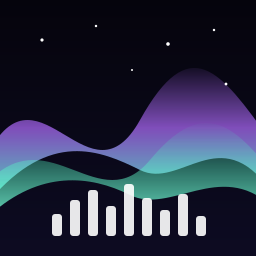
A fullscreen audio visualizer: a black screen and eighteen procedural Metal 4 scenes that
dance to whatever your Mac is playing — nebulae, tunnels, Chladni plates, synthwave hills.
Aurora listens to your Mac's system audio through a Core Audio process tap — no screen-recording permission — and drives eighteen procedural scenes with it: nebula curtains that follow the spectrum, a raymarched tunnel whose walls breathe, 32 768 GPU particles that burst on the beat, a flight over the spectrogram as a glowing heightfield, Julia sets, Chladni plates, ink stirred by curl noise.
Every scene renders in HDR through a feedback stage and an ACES composite, out to an extended-range P3 drawable, so on an XDR display the highlights actually glow. Auto-cycles between scenes, or flip them by hand with the arrow keys.
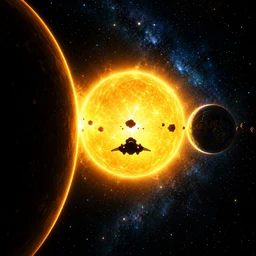
A top-down space shooter in a tiny solar system, written on Metal 4 with hardware ray-traced shadows.
Fly one of ten ships through a small solar system: a sun, three planets, a belt of ~1400 asteroids and six indestructible space bases, with AI miners and haulers running their own economy around you. Lasers, homing missiles, gravity wells and acceleration rings.
Under the hood: an HDR pipeline with ACES tonemapping, hardware ray tracing for shadows, a procedural skybox and procedural sound effects through AVAudioEngine.
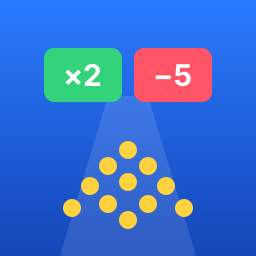
A crowd-runner game prototype: pick the right gates, grow your squad, shoot your way through.
A 2D gate-runner in the spirit of the mini-games from mobile ads — Mob Control, Count Masters — built for real. Pure Canvas 2D with all graphics drawn as vector paths at runtime, zero runtime dependencies.
Turns a Google Meet recording into a clean, speaker-labelled transcript you can correct and calibrate.
A pipeline for meeting recordings: MP4 → audio parts → speaker diarization → high-accuracy speech recognition in two passes → alignment → an AI audit, exported as Markdown, text and JSON.
Prepare the first five minutes, fix two or three characteristic lines, and those fixes calibrate the run over the whole video. Voice samples pin names to speakers. The recording and every intermediate artifact stay on your disk.